Are We Redefining the Wrong Word?

27 Nov

NAGC 2012

 As George Betts pointed out today or last night on FaceBook, this year’s convention of the National Association for Gifted Children was perhaps the most polarized, fiercely divided convention in recent years.  A year ago the organization’s president, Paula Olszewski-Kubilius gave an address that argued the need for the field to come together under the umbrella of a new and singular definition of giftedness, of a unified concept that could and should direct both educational programming and research—Talent Development.  It is unlikely that she had any idea before she gave that speech advocating unity that it would unleash a firestorm of controversy and develop over the following months a split just about as intense and fraught as the current split between America’s political parties. 

Oddly, my own experience of the convention was extremely positive overall.  Others who share my focus on the internal world of the gifted child, and on the fundamental developmental differences between the gifted and other children, had been stirred up by such an overt challenge to and dismissal of their perspective.  They showed up to any sessions that fit that perspective with an unusual level of passion.  I doubt that in the more than 25 years I’ve been attending and speaking at NAGC I’ve ever experienced more enthusiastic and responsive audiences. 

As usual, the Columbus Group gathered after the convention, to share with each other our experiences over the last year and consider what we as individuals and—now that we’re out in the open—as a group, can and should do going forward.  I arrived home wiped out and faced with only two days to get ready for Thanksgiving.  I’ve been home now for a week, and my mind has been seldom at rest as I’ve pondered my experiences in Denver. 

Patricia Gatto-Walden and I did a presentation this year, titled “What the Kids Want You to Know: It’s My Life.”  A group in the UK 20 years ago took the keynote of the World Conference (a speech focused on gifted education as a way to make the best use of each culture’s natural resource of bright kids to benefit their country) to the kids at summer camps for the gifted and asked for their feedback.  Taking a cue from them, we read aloud the shortened version of Paula’s speech that appeared in Compass Points to our Yunasa campers.  Expecting no more than a handful to show up, we invited anyone who wanted to respond to it to share their thoughts for an hour long session.  So many kids (nearly a third of the campers) were willing to give up regular camp activities for that hour, that we could barely fit them into the room we had available.  They spoke enthusiastically for the full hour and several of them asked afterward that we send them the full text of the Subotnik, Worrell and Olszewski-Kubilius monograph that had formed the foundation for Paula’s speech.  

Few of these kids knew anything about NAGC, and one of the first questions they had was, “Does this organization have kid members?”  

We said it does not.  Quite naturally, the kids thought this was outrageous—“How can it be for gifted kids, then?  Don’t they get it that we have pretty good ideas about what we need?  Do they think we don’t think about education during all the time we’re in school?”  

What shocked me was not their question, but that I had never asked it myself.  I’ve been aware, of course, that schools bring kids to NAGC, most often to perform, sometimes to serve as panel members in a session or two.  But kid members? I hadn’t considered it necessary.  

A Moment in the Wayback Machine 

From the time my five year old son had the “head-on collision” with school that led me to begin learning everything I could learn about gifted kids, I have thought that it isn’t really the existence of kids with unusual intelligence that creates a need for specialized “gifted education,” it’s the way education is structured in this country and in most of the rest of the world.  It’s a factory model created well over a hundred years ago and it has changed only slightly since. Children are treated pretty much as interchangeable cogs (or, with an emphasis on product, as “widgets.”) 

At the very first gifted conference I ever attended a speaker said, “If God had known what schools would be like, He wouldn’t have made kids the way he did.”  I thought it was a clever statement, but its full impact escaped me at the time.  After all, school was school!  I’d known what that meant since my October birthday allowed me to start kindergarten at age four in a system with a December cut-off date.  

In the 1980’s, when I had begun to write and speak about the needs of gifted kids, I said in several talks that if school were done differently, we wouldn’t need the designation “gifted kids.”  

People invariably argued with me, pointing out that gifted kids would still learn faster, more broadly, more deeply, and more connectedly than others and we’d still have to diagnose those learning differences.  I agreed that gifted kids wouldn’t vanish—but that if we found a way to individualize education to meet the needs of every student, doing the same for the gifted would be just part of the deal.  I kept remembering what my son said one year when I asked him after we’d moved—yet again!—whether the kids at his new Quaker school would tease him for wearing Kmart sneakers instead of the currently popular expensive brand.  “Mom!  Nobody teases anybody for being different in a school where everybody’s different!” 

The absolute joy of that school was that the children were treated as individuals.  Yes, they went to classes mostly based on age, but within those classes, probably because of their specifically Quaker focus on that of God in every person, each child was respected for being him or herself.  But it was a small school and “everybody knew” (including me) that the whole country’s public system just couldn’t afford to be run that way. 

When that school ran out of grade levels for my accelerated son, I briefly considered homeschooling, because we lived in Norfolk, VA, the only city in the USA where at that time homeschooling was legal. I’d been reading John Holt’s Growing Without Schooling and conversing with him by mail for a couple of years by then, loving his ideas and the freedom they provided for the kids. He didn’t focus on gifted kids–just kids.  A friend of mine had illegally homeschooled her son back in Ohio (which had necessitated “hiding” him in the house all day every day) and insisted that it was the only way to individualize sufficiently to truly meet the needs of an exceptionally gifted child.  But it was not in the cards for my family—I didn’t have the necessary patience and my extraverted son was horrified at the whole idea and refused even to consider it. 

What Do We Mean by Child? 

As I’ve thought about how the two sides in the current definition argument might possibly come together, it has occurred to me that maybe gifted isn’t the problem word.  The problem word is child.  Why does NAGC not have child members, when its stated mission is to serve children?  Because today children are still defined by the field of education not as young individual human beings with individual needs and minds and drives and lives, but as a class of beings in need of being taught by adults what they presumably will need to know when they become adults.  

There is an extent to which that definition makes sense, of course.  Children have a lot to learn and there’s a long period of dependency during which they need to be sheltered, touched and held and cared for, fed and dressed.  Human children need to interact with other humans (though not exclusively with adults) to learn language. Much of what they learn begins with observation and imitation. And of course there are all those tricky things like silverware to handle, stairs to navigate, windows not to fall out of, streets to cross. Plus there are reading, writing and arithmetic, which many of them will first be exposed to in school.  

But what we believe about children has changed. There was a time when a child was thought to be an empty vessel, waiting for adults to fill it up with information.  (Just last year I saw a YouTube about educational reform that actually still said this!)  Science long ago showed that belief to be in error.  Human children are learning creatures determined to explore and manipulate their environment, to test and try, to build and tear down, to question and experiment and interact with whatever other living creatures they encounter—all of which can be classed as “play” in the early years.  And today in any household with technology, they mostly find a way either to use that technology on their own or get someone to show them how. 

The sooner we put them in “school” where the primary activities are to sit still, be quiet, listen, wait for and then follow directions, answer questions “correctly,” and judge themselves in terms of how other children are doing at these tasks, the sooner we begin to limit their natural modes of learning. Instead of play that expands their experience and mastery, learning becomes what they do (or rather what they are directed to do) in school.  There is very little difference in what they are directed to do, one student to another, and little if any concern about individual interests or personal choice.  Natural learning gives way to coercion, solitary activity directed toward a predetermined goal, and a teacher’s external validation or criticism of their efforts. 

(One could ask oneself just what sort of adult life these “lessons” are designed to prepare them for.  Factories, yes.  But factories are either in other countries now or use a lot of robots.  Schools should not be in the business of programming human robots!) 

Meantime, as the Yunasa campers told us last summer, the adults don’t ask them what they need or listen to them when they express their needs anyway.  

And What Do We Mean by School? 

Like it or not, times have changed! How often have you heard one adult say to another, who is struggling with some aspect of current technology, “what you need is a ten year old.” When my now nine year old grandson was two, he was already more adept at using his father’s computer to find what he wanted to interact with on the internet than I was.  Now he scoffs at my efforts to learn something new on my “too smart” phone.  It isn’t only theory that tells us that learners can be teachers and teachers learners.  It is our everyday lives. And there is a tsunami of information available to and through the new technologies that kids are more adept at finding than many of us. 

It is long past time to give up schools or redefine them as learning communities, where it is not just age that creates groups, but interests (passions), knowledge, experience and needs.  In such learning communities there could be webs rather than boxes–language, math, history, geography, art, meant to be dealt with separately in small blocks of time–webs that could interweave what is known in service of creating something new, or helping the learner to grasp new information and move into and understand greater complexity.  And children need to have a voice in how such learning communities would or could operate; because children are unhampered by the structures and restrictions of prior experience; they lack our long memory of “how it has always been” that would hold them back from imagining how it could be.  

Our gifted kids, so very interested in learning, so passionate about exploration, could genuinely help to lead the way.  One of their major differences (at least until we squash it out of them with work sheets and grades and gold stars and tests, grade point averages, boundaries and limitations) is their rage to learn and understand, and to do something with meaning.  Those same kids who discovered at two how to find what they wanted on a computer screen, have ideas about how learning can happen, progress and change.  And how the technology so many of them love and the games so many of them play, could enhance learning for themselves and other kids. They could work with adults who are willing to collaborate on finding the best ways forward rather than determining and dictating those ways! 

Teachers who love their profession and have passion for their subject matter could, in learning communities, be freed to practice that profession instead of struggling to prepare a broad spectrum of kids in a narrow age range to succeed on standardized tests that really can’t measure either student learning or teacher competence. 

We can’t have what we can’t first envision.  And we are in a deep and dreadful rut.  I started a Face Book page (www.facebook.com/deependxgifted) last November in hopes that those who visited it could begin thinking in new ways and sharing their visions about how education could happen if we began over again without schools.  We didn’t get far.  FB pages aren’t that great for collaborative thinking—everything gets pushed down the page and disappears. But that doesn’t mean the discussion shouldn’t be taking place. 

We have to find a way to make things work better.  I would welcome the best ideas of the Talent Development folk, but I would want them to acknowledge the existence of kids whose inner experience of the world really is different from the beginning.    It isn’t just our field that’s in crisis and conflict.  Our whole world is at stake.  Pretty much really!  New thinking, new ideas and new partnerships are essential as everything continues to change at warp speed. Let us outsource factory schools to some other planet so that we don’t have to find ways to keep squeezing human children into boxes designed for widgets or robots.

I end all my talks with the following quotation, meant for every human, child or adult, because we need to know that we are not interchangeable!

“You are not accidental.  Existence needs you.  Without you something would be missing from existence, and no one could replace it.”  –Osho
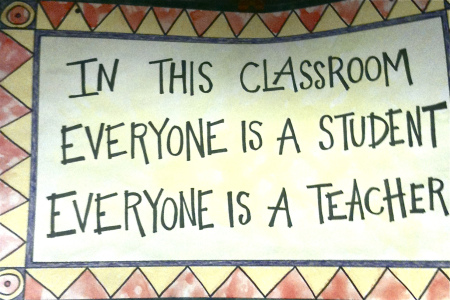
Found this on A Space for Learning, 11-12-12
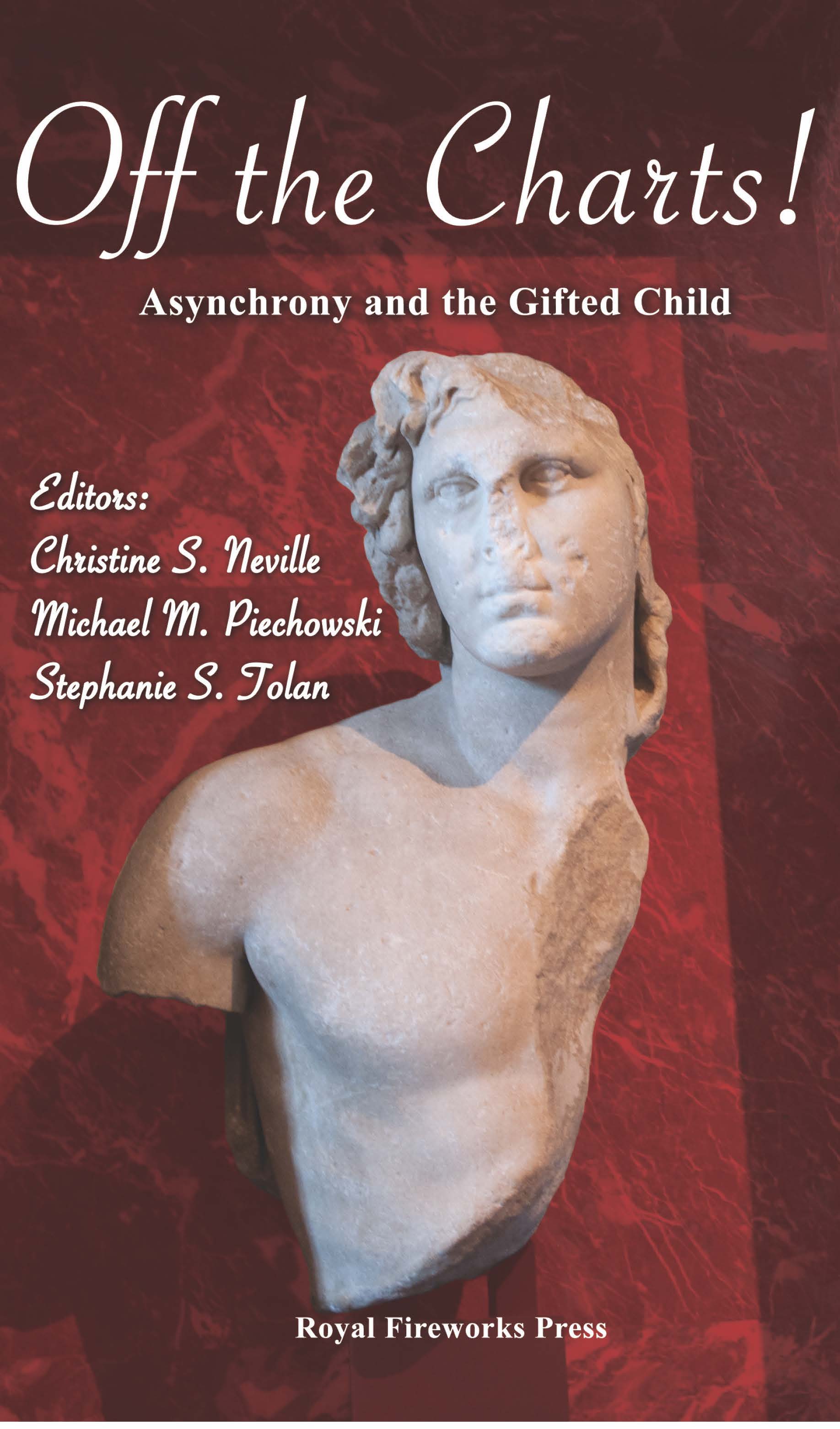
Off the Charts! — Book Debut

13 Nov

Twenty years ago the field of gifted education was beginning to define giftedness very specifically as achievement—as doing rather than being.  One of the leaders in the nation’s gifted community was claiming at that time that schools “created” giftedness and that children who were not achieving academically were clearly not gifted (and therefore should not be taking up the limited numbers of “seats” in gifted programs).  Dismayed by the narrowness and external focus of this definition, a group of us whose experience with the gifted had shown us that unusual intelligence was an internal aspect of the child, apparent well before the start of school, gathered to discuss how we might help to refocus attention on this way of understanding the gifted population.

Out of our meeting in Columbus, Ohio in the summer of 1991 came the definition of giftedness as asynchronous development that was quickly recognized and adopted by many teachers, parents and counselors throughout the country and around the globe.  A phenomenological view of unusual intelligence, it provided a way of comprehending both the potential for extraordinary achievement and the struggles the gifted face in being out of sync both internally and with the expectations of the broader culture.

Last year at the national conference of the National Association for Gifted Children (just a few months more than 20 years after that first Columbus Group meeting) the suggestion was made in the presidential address that the field of gifted education should unify its disparate viewpoints by adopting Talent Development, with its clear attention to the issue of extraordinary achievement, as the single driver of both this field’s educational programming and its research.   So it was that members of the Columbus Group, that has continued to meet throughout these two decades, decided it was an important time to put out a book to remind the field of the critical “other side” (the inside) of giftedness, which is part of the gifted individual’s experience whether in or out of school, whether achieving in the eyes of the world at any given moment or not! 

So, we’re thrilled that the book (conceived only a year ago, and with chapters from 14 experts on the needs of gifted and highly gifted individuals) is to be available online from Royal Fireworks Press (http://rfwp.com) as of today (though at 1pm EST it wasn’t yet up on the website).  Dedicated to the memory of Annemarie Roeper, the book includes her last writing about the population of children to whom she devoted her life. 

We had hoped to have the actual books at NAGC this week, but weather (a modest incursion of Hurricane Sandy on its way to devastating the North East) intervened and stopped electricity to the presses.  

Prepublication discount!  The list price of the book is $30 but for online orders this week (through November 18th) the price is $25. 

Included in the book are chapters on the historical foundations of the definition, methods of identification, characteristics of asynchronous development, understanding individual needs, gifted adults, counseling, parenting and family issues, and educational options from a group of authors, each of whom has decades of experience working with, researching, and writing about “off the charts” kids and families.  

On a personal note:  the other thing that happened last year at NAGC that particularly motivated me when the idea for the book was being considered occurred at my presentation for the Counseling and Guidance network called “The Asynchronous Cheetah.”  (My cheetah metaphor was developed originally for a keynote at the Hollingworth Conference for the Highly Gifted in 1992—the same year the first article about asynchronous development was published in Understanding Our Gifted.)  When I mentioned the Columbus Group during that presentation, an attendee raised her hand and informed me that when she had been doing some research on asynchronous development for her graduate degree in gifted education, her professor had informed her that the Columbus Group didn’t exist.  “It’s a fiction,” he told her. 

Laughing at that representation, I explained that not only was the Columbus Group not a fiction, but it had actually met the evening before in the conference hotel. 

It’s quite true that I’m a fiction writer, and I’m really fond of fiction and the fundamental truths that are often explored in the pages of a novel.  But I prefer not to think of myself as fictional.  So–for those who may be interested in the Columbus Group’s “true story” and the reason a leading figure in gifted education could make the assumption that it wasn’t real (as a group, we have flown quite purposely under the radar all these years) I wrote an introductory chapter giving the “true story” of that 1991 meeting and the definition that grew out of it.  So if you’ve ever tried to find out more than what could be gleaned from the usual citation of the “unpublished transcript” of that meeting, you can learn why you couldn’t.  There are hours of audio tape from that meeting, but no plans to publish the transcript!

Tomorrow I’ll be off to Denver for NAGC 2012 and hope to see some of you there.

Strands of Light

2 Nov
Hurricane Sandy

It has been a long time since I have had the time, combined with a strong need, to write something for The Deep End.  This week provided both, when the fury of Sandy-the-Super-Storm shut down a surprising amount of what passes for normal on our continent.  Yes, lots of us –most of us—were outside the storm path, but given the importance to our country of the Northeast coastal states, there has been something of an enforced pause.  Many people who meant to fly somewhere ended up somewhere else, or not flying at all.  The power grid that we so fully depend on proved once again to be fragile in the face of wind and water, and the edges of our country that looked one way on Google Earth one day looked very different the next.  It isn’t a disruption that can be ignored.

“What passes for normal.”  It’s a phrase that the storm washed up in my mind the way it washed boats onto railroad tracks and shoved cars into a tangle in lower Manhattan parking garages. As a person who now looks for what there is to be grateful for in any given situation, I am still hugely challenged by the Big Bad Events that are occurring with apparently greater and greater frequency on our planet.  One can, of course, be grateful that any one of those events hasn’t happened to us personally (not only did the storm pass us by, but our kids and grandkids in New Jersey and NYC came through it okay).  Still that doesn’t feel enough in the face of images of people who very much are NOT okay. 

In the thirty-plus years I’ve been paying particular attention to extremely bright kids, one of the things that I’ve noticed and written about is their tendency to question what passes for normal, often because what passes for normal (the expectation about who they should be and how they should function for instance) doesn’t work for them.  But that isn’t the only reason they question it.  They notice that what passes for normal doesn’t work for others, either. 

One of the reasons super bright kids are at risk for an early experience of existential depression is that they’re able to conceptualize how the world ought to be, and are aware, from their own observation or the daily news stories, of how far from that ideal it really is.  They may see that adults—the people who “run the world”—either somehow don’t notice the gap between ideal and real, or don’t care enough or aren’t smart enough to fix it.  That can be really scary.  From global issues of war, poverty, hunger, environmental destruction, animal cruelty to unfairness in the classroom and bullying on the playground, these are all, to one degree or another, considered normal and the kids are aware of and upset by that. 

When far away catastrophes happen, child psychologists are often quoted in the media, advising parents to assure frightened or upset children that those bombs or that earthquake or those wildfires won’t come near them, won’t take their houses or their loved ones or their pets.  But even very, very young highly gifted kids are not frightened and upset solely about themselves!  They are upset for those these catastrophes really are happening to. Many of these children feel connected to the other beings in the world, from people to animals and plants.  They seem from the beginning to “get it” that when one strand of the web of life is stretched or broken, the whole web is affected.

For this reason I have often called these children the “necessary other,” the individuals in our species who are able to perceive in new ways, invent new possibilities, demand changes in what isn’t working, because they see and feel what isn’t working.

But the other night, when I was lying awake worrying about how the city of New York and the northeastern states faced with such immense destruction were going to be able to make things work again, an image came into my mind of strands of light reaching from person to person all across the country, gathering in all those places affected by the storm and providing more light and warmth in that cold darkness.  Some strands were very, very thin, no more substantial than spider webs, some were larger and brighter.  But there were a great many of them–millions

It came to me quite clearly that human beings are social animals by their very nature.  When we see images of other beings in pain, we have an innate impulse to reach out, to help, to share resources.  The images that come to us from the devastation of something as massive as that storm are not just images of destruction, they are also images of people helping each other.  Some of those helpers are workers who have chosen to be the first responders to trauma, but many—probably most, many of whom don’t get on camera—are just people who see a need and choose to help. 

Maybe it isn’t so much that these super-sensitive kids are “other,” but that they develop those deeply human impulses early and powerfully, and insist on expressing them.  As with the other over-excitabilities, their empathy is aroused by a smaller stimulus and affects them more deeply over longer periods of time than is true of other kids, or even of many adults. 

During the cold war when there was a great deal of fear in this country about a possible nuclear war with Russia, it was discovered that children’s fears could be alleviated a bit if they saw their parents or caregivers taking some kind of action, however small, in favor of cooperation and peace.  This is a time to do whatever we can to show that we are “doing something” to help the people whose lives have been devastated.  For some of us it can be contributing money to relief agencies, or helping to organize fund-raisers.  Kids can help with any and all of this and get a sense of empowerment. 

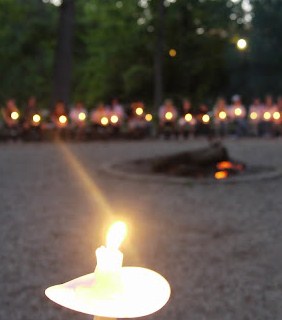
But there are other ways of “doing something” as well.  One way is to reframe the whole story for our children.  We can point out all the examples of people helping people.  We can assure them that even though what passes for normal among humans may have flaws and compromises, this species they belong to has a deep impulse to cooperate, to share, to care!  When a strand of the web is broken there is always a rush to repair it.  Not every single individual may be willing to put another’s needs first even when catastrophe occurs.  But many do, and the light of their willingness to help, like a single candle in a big, dark room, pushes back the shadows a bit.  Every “strand of light,” of caring, that reaches from one person to another is real and has an effect, even if we can’t always see it.  As The Little Prince tells us, “What is essential is invisible to the eye.” 

Pondering the Olympics Yet Again…

5 Aug

Every time the Olympics come around (winter or summer) I am thrown into contemplation about the difference in cultural acceptance between finding and nurturing children whose innate attributes show them to be potential athletic superstars, and finding and nurturing children whose innate attributes show them to be potential superstars of the mind.  The whole world seems to understand and accept the need for these physically adept kids to have unusual coaching, to be withdrawn from “normal expectations of childhood activities” in order to focus on and develop their gifts, and to find some way to support their passions.  Everybody seems clear that you have to “set the bar high” to encourage growth and improved performance, and that the child himself or herself needs real inner drive and passion to flourish in such a work-focused atmosphere.

This is not, of course, to say that the path from discovery to Olympic superstardom (or otherwise) is easy, for kids or coaches or parents.  There are emotional prices to be paid all the way around.  When we watch a youngster (or occasionally an adult) devastated at getting a silver (only second in the world?) as if they have failed, a twinge of annoyance may accompany the compassion.  But we understand the cultural pressure to be “the best,” and its emotional effect.  And we celebrate the moments when an excited newcomer says what a thrill it is to be at the Olympics at all, or a driven competitor dances with real joy at winning a bronze.

With every Olympics, as I listen to the stories about how these young or adult athletes are models for younger kids, who watch their heroes breathlessly, imagining their own future possibilities, developing their own passions and sense of personal power, I long for that same story to be told for and about our brilliant kids.  NBC focused a moment last night on two kids from North Carolina (the state I live in) who traveled all the way to London to watch Michael Phelps go for more gold.  The story celebrated the effect of role-modeling.  And I got a little wistful.

But this year, fresh from the week of our most recent Camp Yunasa, I find myself processing this all a little differently.  Yunasa is the Lakota word for balance, and we created the camp for highly to profoundly gifted kids in a quite purposeful way to focus on “wholeness.”  There is a spiritual focus that pays attention not just to the unusual gifts these kids bring into their lives, but also to the meaning they can find in being and developing who they are.

photo by Nicholas Farrell

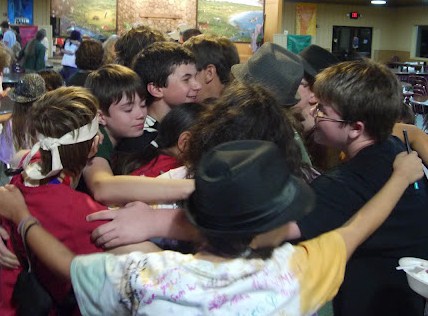
Like most camps, Yunasa wants the kids to have fun, and like most camps specifically for gifted kids, one of the most important things campers get out of it is the opportunity to hang out with their “tribe,” to make friends with kids who get them, enjoy many of the same things, laugh (amazingly enough!) at their jokes. Yunasa is known for group hugs! 

photo by Nicholas Farrell

But we structure the experience carefully around five attributes of individual life: mind, body, spirit, emotions and social self and ask the kids to consider the need to give some attention to all of these.

My own hope is that our campers–particularly those who come back year after year–will become mindful of the meaning of their own gifts and passions, resilient in the face of the world’s lack of understanding, and resistant to a cultural message that defines the value of a human life in terms of competition and winning.

The contrast with the Olympics could not be clearer to me this year.  The absolute focus on competing and winning is inevitable in these games.  Add the national pride issue–which country wins the most medals–and for the first time I’m feeling also a little grateful that the spirit of the Olympics is not readily transferrable to nurturing our brightest minds.

Ideally, in service to the competition, individual passion and effort and skill are celebrated in these games.  And teamwork, too.  What I would love to see is the best of the spirit of discovering gifts, nurturing passion, effort, skill and cooperation that is exhibited in the training of Olympic champions provided also for young unusual minds–along with real celebration of those gifts!  But I would also want for our mermaids/cheetahs a focus on the importance of the whole self and the meaning of that self in the tapestry of life.

Schools are to Creativity… (Part 2)

16 Jul

…as zoos are to wildness.

I got to visit cheetahs NOT on exhibit at Melbourne zoo–thanks to Jo Freitag

Sometimes in order to see things clearly one has to peel back layers of feeling. My philosophy is that we can’t do anything wrong (as we’re doing the best we can at any given moment) but that we may be able to do things better, and feelings can help us do that by pointing to what isn’t working as well as it could.  Today’s post goes on from the feeling response I wrote yesterday.  Different readers will respond differently, depending on their own feeling layers, of course.

“…As zoos are to wildness.”  That is a critical part of the sentence!  I am not against zoos.  In fact, I spent part of my life wanting to be a zookeeper.  I had our family read aloud the works of Gerald Durrell, whose life, other than writing, was devoted early on to gathering animals for zoos and then to creating an important zoo of his own.  One of the greatest synchronicities of our son’s life happened during his college semester in London when, looking into a bookstore window, he thought he recognized the reflection of the man standing behind him.  He turned and asked the man if he was Gerald Durrell.  When the man said he was, our son enthusiastically shared how important Durrell’s books had been to his childhood.  Durrell invited him to the zoo run by his Wildlife Conservation Trust, and of course he went!

As with schools, there are zoos and zoos.  Fewer and fewer of them are places of imprisonment for their charges or focused solely on putting animals on exhibit for the entertainment of their paying customers. Many do important conservation research.  And there is for the most part a serious effort to provide as natural a habitat for the animals as possible.  Nevertheless, the task of maintaining wildness is difficult to achieve with some species and impossible with many others!

Just so with highly creative kids.  Creativity itself is about not following directions, about finding new ways to do things, new ways to approach things, new ways to put things together or “reconcile the disparate.”  It is an individual thing.  An institution whose job is to educate all kids cannot function without requirements, directions, methods and–yes–coercion.

One of the most difficult half hours of my life was the first time I was asked as a visiting author to interact with a kindergarten class.   I’d written mostly young adult novels at that point and normally visited upper elementary or middle school classes, where I started by getting the kids excited about an idea.  I had literally never been in a room with more than 20 five year olds before that day.  I made the mistake of starting by getting the kids turned on.  Five year olds, of course, pretty much don’t need turning on–chaos ensued. And I never managed to restore even a semblance of order.

Creativity and institutions of any kind don’t go together easily.  At best there may be an uneasy alliance.  Institutions need patterns that creative people break.  Over and over again the “creative genius” who founds an organization of any kind–a company, a school, a theatre company–is replaced once that organization is up and running by someone whose particular skills are suited to  guiding and maintaining rather than inventing.  And it isn’t always that the founder is thrown out–some leave when they discover that keeping the organization running bores them silly and that making things new all the time can be disruptive and threatening to others.  Creativity often looks like destruction, when old forms have to be taken apart to make way for the new.

When that sixth grade teacher who was the nemesis of my life told my mother that I’d never amount to anything because I was “interested in too many things,” she was thinking along conventional lines:  “jack of all trades, master of none.”  The greatest joy of being a writer, of course, is that I get to keep writing different sorts of stories, doing different kinds of research, inventing whole new people and worlds.  One of the things that made me craziest in school was the schedule–same classes same day of the week, week after week after week.  As an adult I would not be able to do a job that involves constant repetition.

So this is the second half of what I wish to say about creativity in schools.  We can’t support it perfectly, but we can keep working to do better. Some schools and some teachers have more success than others in making room for creative kids, but much of the support the kids need may have to come from the fact that–unlike zoo animals–they get to leave the building at the end of the school day.

What I wrote during school was mostly written in the classes I didn’t like under the guise of taking careful notes (the notes my teachers thought accounted for my good grades.)  But most of my writing as a kid was done in trees, under bushes, at home in my room–outside of school and not at anyone’s request.

It is possible for a creative kid to survive even the most coercive school environment with a little help from outside–parents, other kids, adult mentors or just enough time and space to dream, and materials for playing, experiencing and inventing on their own.

But kids whose creativity can be submerged by doing really well at following directions, by a culture that is uncomfortable with rebels, or by a need to protect themselves from the hostile forces often ranged against them, do get hurt.  There is no life without pain; I’m not suggesting there should be.  But often these kids get hurt more deeply, more often and more permanently than necessary.  Coercion can inspire creativity as the creative kid finds ways to rebel against it or work around it.  But coercion can grind down and destroy as well.  These kids need to hear from adults that resistance is not necessarily a sign of poor character!

“If I had it to do all over again” (something every single parent can say at some point), I would put supporting creativity way higher up on my list of priorities for any kid who has, in addition to a really fine, really capable intellect, a passionate imagination and a drive toward novelty.  It was the nourishing of imagination that Einstein was talking about when he advocated reading fairy tales as a way to create future scientists.  When he said that creativity was more important than knowledge, it wasn’t that he was dissing knowledge.  But stuffing kids’ minds full of the knowledge we think they should have doesn’t make room for what is likely to be needed in a world we can’t predict that will be the world of their adulthood.

I prefer to look for positive possibilities.  If some kids can nourish their imaginations with computer games (like the paper version of Dungeons and Dragons that briefly took over my son’s life) I say there is hope in that.  But I also hope that anyone who can affect classrooms anywhere will keep in mind the need to provide some open spaces for the growing of imagination.  And I would remind parents to value and trust it as Einstein did.

Schools are to Creativity…

15 Jul

…as Zoos are to Wildness.

This was the title of a talk I first gave before I entered the realm of giftedness.  I’ve used that title many times since.  But this morning, when I had been planning to start preparations for camp (Yunasa begins a week from today and I leave home on Wednesday), I found this article (Why Creative Geniuses Hated School) posted in the FaceBook group, International Gifted Education, and was motivated to write a blog post instead.  If you haven’t already read that article, please, please click the link and read it before going on.  (I’ll wait.)  ***

I’m not writing here to bash schools, though that may seem to be the effect of this post.  I’m writing because it is difficult to know what to do about this problem, and it’s a serious problem that too many people (including myself for a long time) overlook, ignore or just don’t realize or understand.

I don’t claim to be a “creative genius.”  But I was not just a highly gifted kid, I was a highly creative kid.  I didn’t, of course, know this prior to entering school.  I had a vivid and constantly active imagination, but assumed everybody did.  School gave me little to do with that imagination, but then it gave me little to do with the rest of my mind, either, so I guess I just didn’t notice.

In the early days school for me was mostly a place where we kids were asked to do things that didn’t make a lot of sense.  I remember, for instance, cutting out words from a work book and pasting them under a picture–“apple” got pasted under the picture of an apple, “cat” under the picture of a cat.  I couldn’t imagine a reason for doing this, but the teacher wanted us to do it so I did it, along with all the other apparently useless tasks we were given.  And I got stars for doing it.

I was a girl from a family where authority counted, and it was the ’40s.  I pretty much did what I was told and enjoyed the stars.  The stars became S’s (for satisfactory–the only alternative being U’s for unsatisfactory) in grade school and A’s and the occasional B in junior high and high school, then in college and graduate school.

Long after my formal connection with school ended, Jane Piirto asked me to be part of a study she was doing of successful women writers.  The participants were asked to fill out questionnaires about their school experiences, and I did that.  My answers made it clear that not only had I been an excellent student, but I had pretty much loved school.

Years later, when I had become known as an expert in gifted education, I spoke at a conference in Nebraska that was organized in honor of the 50th anniversary of Leta Hollingworth’s death.  During that conference a film about Leta’s life was shown in which a poem of hers was read over suitable nature images–I believe it was titled “The Lone Pine” and she had written it in high school.  During the reading of the poem I began to cry.  The poem was one I certainly could have written at that age myself, about how hard it was to stand out, to stand alone on the top of the hill taking the brunt of the winds instead of standing safely down on the hillside, sheltered amongst the rest of the forest trees.

By the end of the film I had put myself back together, but during the plane ride home from the conference I found myself crying again.  The amount of pain that bubbled up over the rest of that day stunned me.  And when I got back to my computer, I spent six full hours writing, retrieving the “real story” of my school experiences from second grade on.

The protective cocoon of repression had broken as I listened to and identified with the feelings behind Leta’s poem, and I gradually came face to face with what school had really been for me.  In my own life, it hadn’t been other kids who bullied me–the bullies were defensive teachers who humiliated me, including the sixth grade teacher who arranged for the principal to denounce me as a liar and thief to the whole school over the intercom.  I hadn’t managed to repress that singular event–I had just put it down to the teacher’s vindictiveness.  But I had genuinely forgotten the others and the pain they caused.  The cocoon had been largely constructed of all those stars and good grades, the dutiful accomplishments of a bright kid whose schools and family expected her to follow directions, to achieve and excel.  How could I not have loved school when I was so successful at it?  When I filled out those questionnaires, I had genuinely believed my answers.

There were bright spots, of course, and a handful of caring, supportive teachers.  Luckily, I’d had one brilliant teacher at my highly academic school who taught me English all four years of high school, and gave us wonderful  literature to read and had us do free writing known as “journal entries” every single week.  Luckily also, the school had a powerful drama club and I’d done theatre as an extracurricular activity throughout. 

I majored in creative writing as an undergraduate, writing stories, poetry and plays–and again focused all my non-academic attention on theatre, surviving the “core curriculum” by getting through it as fast as possible and spending most of my time focused on my passions.  But as a graduate student I was not allowed to write a creative thesis (the volume of poetry I’d intended) for my Master’s degree and was required to do a work of literary criticism instead.  When I read today that Einstein had “found the consideration of any scientific problems distasteful” for an entire year after forcing himself through his examinations, I was reminded that my Master’s degree in English Literature very nearly stopped me writing entirely.  I have never darkened the door of a school (as a student) again, in spite of pressure to get a doctorate in order to keep a university teaching position.

Over my thirty years in the gifted field I have regularly been called “Dr. Tolan” by people who simply assume that an “expert” must have a doctorate.  And there was a time when a competetive colleague suggested that a “mere children’s book writer” could not possibly have the credentials to function in the academic world.  I’m not against doctorates–most of my closest friends and colleagues have them–but acquiring one can be harmful to imagination and nearly poisonous to creativity!  The words “terminal degree” still make me chuckle.  It could have been that in my life!

This post is not meant as a personal complaint.  I’ve had a wonderful life doing multiple things I love to do.  The main reason for writing here is not because my own creativity was damaged or at least thwarted by school, but because I bought into the education paradigm so thoroughly that I failed to make my own son’s immense creativity the primary focus of our attention when he was growing up.  I was seduced by his amazing mind.  I wrote about that a bit in my “who/what” post in this blog here.  Luckily, he never convinced himself that he loved school, and he wasn’t seduced by the demand for multiple degrees as the only doorway to success or fulfillment.

I was moved to write today because it isn’t only the “creative geniuses” who are hurt by school (and of course because when they’re children we don’t yet know who those geniuses might be.)  It’s all the kids whose innate creativity goes unsupported in school.

How many kids are out there with vivid, passionate, creative imaginations and also extremely able intellects, whose “success” in the academic realm (good grades, high achievement) is masking severe  malnutrition in schools that don’t make their imaginations a priority and their curiosity an organizing factor in their education?  (Especially in this era of high stakes testing!) 

How many kids might one day claim as I did (like kidnap victims exhibiting the “Stockholm syndrome”) that they had loved the schools that nearly destroyed the essence of who they were?  And how many rebellious, angry kids are that way because such a huge piece of who they are is ignored after kindergarten or first grade, as kids’ stuff?

Einstein said that if we want to raise fine scientists we should read them fairy tales.  Given how few schools these days follow that advice, one must hope that computer games are filling some of that need…

Raising Exotics

11 Jul

Long, long ago (1988 to be exact) I wrote a piece I called “Giftedness–Nature or Nurture?” It was not an academic piece attempting to answer this old question.  It was a gardening metaphor that I hoped would assure parents that the task they faced raising highly gifted kids was as tricky as it felt, but possible.  It was written in first person plural because I, too, was a parent facing uncertainties.

As written originally, I don’t recommend it!  But when I was talking recently to a parent fairly new to dealing with her more than usually unusual PG child, I thought this pre-cheetah, pre-mermaid metaphor might at least help her not only recognize but accept the challenges and begin to trust herself to meet them.  So here’s an update for just that purpose:

When we have a baby it’s like being given a flower seed that it’s our job to grow. Determined to be responsible gardeners, we start by doing the normal and absolutely necessary things. We plant it. We water it.  As it first sticks its white-and-soon-green self up through the ground, it looks pretty much like any other brand new seedling.  Maybe this gardening thing won’t be too hard, we think–after all the world is full of other people doing it.

But when the young plant begins to put out real leaves, they look nothing at all like the leaves of the plants people around us are growing.  Our seed didn’t come pre-labeled in a package that included an explanation of its needs. Full sun? Partial shade? Acid or alkaline soil? Lots of water or hardly any? Sand or loam? The gardening books and the gardening sites online don’t seem to show the specific sort of plant we’re dealing with.  Our seed, we eventually learn, is an “exotic.”

We can’t tell at this early stage whether it’s going to be 4-6 inches high (good for a garden border) or 24 inches high with an absolute need for a fence or stake to lean against. Is its blossom going to appear early or will it bloom only after several growing seasons?  Will the flowers be so large and spectacular that the stem will bend over from their weight, or will it have tens or hundreds of tiny flowerets clustered around the stem so that no single one stands out? We begin to realize we’re going to have to be ready for anything.

What pests are likely to damage it? Is that wasp buzzing around it going to lay eggs that will sap its strength or disfigure it, or is the wasp only going to pollinate the flowers? And how do we tell before it’s too late?

Mostly, as the plant grows we do what we can and hope that we’re doing it right, or at least not too badly wrong, second-guessing ourselves at every turn. What we want is expert help, so we visit garden clubs devoted to raising exotics; we read blogs written by experienced exotic garden specialists.  None of our efforts turn out to be quite as comforting as we’d hoped.   Exotics must absolutely have shade one expert says.  But our plant seems to be constantly leaning out for sun.  Browning leaves, a leading blog tells us, mean we’re giving it too much water–either that or we’re giving it too little.  Which is it? we ask in frustration.  And how do we tell?

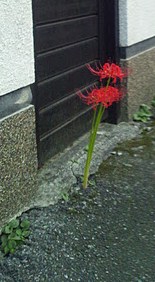
“Everybody knows” of course, that exotics are sensitive and particular and must be treated with extreme care and given precisely what they need, or they will be irreparably damaged, their blooms stunted or perhaps destroyed in the bud.  There was, of course, that exotic seed that got dumped in a parking lot and ignored and somehow managed to find a crack in the pavement and bloom anyway.  That one gets coverage on the nightly news, but many passionately committed gardeners rush in to remind us that it was a one in a million miracle and we should not be lured into letting down our guard.

But here’s something all gardeners can be sure of.  Each individual seed comes with the whole blueprint, the whole plan, and all the “design capacity” necessary to become what it is meant to be.  As important as nurture is, nature is considerably more resilient than we may believe.

Yes, it’s a particular challenge to raise an exotic.  But close observation, common sense, and some basic gardening instincts are amazingly useful.  It’s fine to check out the exotic gardening clubs and the expert blogs and listen carefully.  Much of what can be learned that way will be helpful.  But if your plant leans toward the sun, no matter how many others (even the experts) claim shade is essential, go with sun.  If, after a time in full sun, the plant begins to wilt–don’t be too frightened to transplant to a slightly shadier location.  Watch and listen, and trust yourself.  And don’t forget that plant blooming in the crack.  Miracle, maybe.  But in some ways every seed is a miracle.

Surf’s Up!

21 Jun

“There is no security in following the call to adventure.” – Joseph Campbell

Yesterday, in the midst of “ordinary life,” my husband and I got news about one of our grown sons that rocked our world and changed what I had thought to write for the New Zealand blog tour.  For a moment, I thought I might not write anything at all, but when the ground began to settle under my feet, I knew there was a different message here.   No matter what their age, it is not possible to protect your children from life itself.

I’ve loved being an elder in the realm of gifted—past the stage of active parenting, past even the stage of believing my job is to change the world for this population I care about so much.  A long enough life provides one with lots of stories—many of them stories that no one could have predicted, no matter how assiduously they study what’s known, no matter how many experts they consult,  how carefully they plan, or how strong their desire for control.  If you can stay open, life gives you plenty of opportunities to change your mind, change your strategies, and keep on growing.  And it knocks you down often enough that you begin to trust that you can get up again.

When I write about giftedness, more often than not I write for parents.  Parenting is by its very nature a tough job—parenting gifted, out of the box kids provides unique and sometimes daunting challenges.  As parents it is in our very nature to want the best for our kids.  But here’s the tricky part—there’s no way we can know just what that is.  Sometimes the best is paved with ease and the worst looks like catastrophe.  And sometimes the opposite is true.

Whenever I read the questions parents post online and the answers other parents share, I tend to feel with them the struggles and the anguish they encounter when they see that the world is constantly trying to shave off the edges of their beloved square pegs in order to get them to squeeze down into the available round holes.  Life for gifted kids can be hard, tough, painful.  (And seeing our kids in pain doesn’t just push our parent buttons.  It all too often calls back for us what we ourselves lived through—so it’s natural that we want to stop that pain for them, to smooth out the bumps or widen the culture’s holes so square pegs can be valued more and fit more easily.)  Wanting to do that is natural.  I spoke about it years ago at NAGC—the article from that talk, “The Problem of Pain,” can be found here.

But watching parents wear themselves out trying to smooth the way, and looking back over my own life, I want today more than anything to remind us all of the magnificent theme of the 2013 World Congress Conference that is being held in New Zealand:  “The Soul of Giftedness.”

What does it mean to consider the soul, the spirit, the intangible essence of self that each human brings to life’s journey?  The story I’ve been sharing with audiences and readers for a while is that each of us is the hero of our own life story.  As a writer I could use the literary term protagonist, but I prefer hero because of the sense of courage, strength and passionate intensity the word carries with it.  What animates the hero is soul, spirit, intangible essence of self.  Our kids come into the world with that—every single one of them—and however fragile the child might appear, soul is indomitable.

At Yunasa-West last week I asked the campers what was the phrase surfers use to alert each other that it’s a really good day to grab their boards and head to the beach.  Few of those campers are surfers themselves, but they knew the answer.  “Surf’s up!” they called out.  Yes.  Of course.  The thrill, the joy, the challenge of surfing has to do with waves.  It isn’t about sitting on the board on a calm sea, admiring the blue of the sky.

As the kids answered so enthusiastically, I had this image suddenly, of a veritable army of parents rushing out to the beach ahead of their children and doing their best to calm the waves, to flatten the sea.  I understand their wish to protect their kids from a wipeout. I also know that if we were able to do that, we would be depriving our young heroes of the very challenges that provide the exhilaration, the thrill, and the practice that can lead them to be the best surfers they are capable of becoming.

I’m talking paradox here, and paradox, however much a part of our world, is difficult to live with.  It is a parent’s job to protect each child from harm.  We wouldn’t send our beginning surfers off to face a tsunami.  But if we allow our own fears and our sense of our children’s fragility to keep them away from the surf, we may block them from discovering the inner tools and capacities of spirit any life journey requires.

We have no idea what lies ahead for the children of today, except that it will be something humanity has never faced before.  Just as we want our children’s minds to be challenged to prepare them to make the most of the special gifts they have brought, it’s worth remembering that their spirits, too, grow from challenge.   Some of them may have come on purpose to become champion surfers of the tsunamis of change.

The truth is, we can’t disperse all the ripples and flatten all the waves no matter how much we might want to do that.  But we can let our children know that they are heroes, that they have indomitable souls and that sometimes instead of fixing the world for them, we will be there to listen, to bind their wounds, to love them through the healing process, and give them a time and a place to rest between waves.  We, too, need to be heroes, have indomitable spirits and face each day, each ripple or wave as it comes, whether it comes to us or to them.

Meantime, it is worth a bit of extra effort to model gratitude and appreciation for the journey itself.  That way we can celebrate every triumph,  take joy in every calm beautiful day, and be fully present in every moment, whatever that moment brings.  Every journey happens just one step at a time.

http://ultranet.giftededucation.org.nz/WebSpace/696

“…a Man’s Reach Should Exceed His Grasp…”

20 May

How many of us were told at some point in our lives that we were not living up to our potential

I was.  I was a high achiever in school—mostly A’s, a fantastic (probably intuitive) ability to take tests.  But my potential?  Suppose I got a 98 on a test.  “What happened there?” my father would ask.  Once, the Director of Studies at my high school wrote a note on my report card about the B+ I got in a demanding, college-level biology class.  “For a person of Stephanie’s potential,” her note said, “a B+ is not an acceptable grade.”  There was in my world the idea that there were only two alternatives:  A (better yet A+) and F; perfection or failure.  

It has taken many decades (and some costly therapy) to extricate myself from that mindset.  As Linus, in the Peanuts cartoon, says, “There is no heavier burden than a great potential.” 

Just in the last few weeks, during all this conversation in the “gifted realm” about achievement and eminence (an old conversation that has only taken on this recent intensity because of an effort to make it holy writ instead of a conversation), I have come to see the charge of not living up to one’s potential as a toxin.  These days we worry about toxins in our food, about dangerous drugs, about tainted air and water, but we freely dispense the toxic judgment of unfulfilled potential to ourselves and our children (most especially those labeled as in some way more full of “potential” than others). 

Eleven years ago in an online seminar I was conducting, a mother expressed concern that if her child chose to follow some deep current interest, he might not reach the top of his field.  That was her goal for that child—to reach the top of his field.  I have talked about the cages schools create for cheetahs—think of what a narrow goal it is, what a tight and limited pathway such a goal creates for any person, let alone any child.  How could he even be sure the goal had been attained—isn’t it pretty much always a matter of opinion?  (I can’t help thinking of Edison and Tesla for instance.)  And if he could somehow prove he had reached the top, how long could he stay there?

This toxin is often put out with the best of intentions.  Whether it’s a teacher with a bright student who doesn’t turn in homework, a mother worried that a child isn’t getting the support necessary to develop her unusual intelligence, a politician concerned that we are losing the productivity of our finest minds, or a father furious over his son’s laziness or passion for video games, people seem to think that living up to one’s potential is a good and necessary thing, perhaps the only road to success. 

Here’s the thing.  None of us lives up to our potential!  We all use only bits and pieces of our minds.  Even if we were to leave out the distinction between mind and brain, we know that the potential of the human brain is vastly complex and no matter how fervently we study it, its capacities continually astonish us.  

Savants have been the source of many surprises, of course.  From “Rain Man’s” ability to instantly tell how many toothpicks spilled out of a box, to Leslie Lemke’s ability to play full length classical piano pieces after a single hearing, to Stephen Wiltshire’s ability to fly over a cityscape and then draw what he’s seen in excruciating detail and perfect scale, the things savants can do confound us and send us searching for explanations of how certain brain deficits might result in extreme surpluses of one kind or another.  Still, the very fact that any human can do these things means that such a potential exists (one way or another) in the human brain. 

There are a great many mental capacities that most of us would consider “impossible” that are not only possible to some individuals but may be available to anyone open to experiencing them.  There are people who are able to read with their hands rather than their eyes, for instance.  I first encountered this phenomenon in a woman with extreme intuitive capacities, who was also dyslexic.  So difficult had reading been for her as a child that she was driven to find an alternative to using her vision in order to access the information on a written page.  She discovered that she could “download” what was on the page by running her hands over it.  

I know of at least two people who have conducted experiments to test for this ability with young children, who report that this is not a rare phenomenon—just one that our current theories of brain and mind can’t explain.  The younger the child (therefore the less caught in our ideas of what is and is not possible) the more likely that child is to be able to acquire information from a printed page this way—both photographs and words.  Says one of those experimenters, “We could probably all do this, but nobody ever told us we can, so we have never tried.”  The other has found that some adults can do it as well, but with considerably greater difficulty.  (I can’t, of course, give you citations from peer-reviewed scientific journals for these experiments—they are not the sorts of experiments scientific journals are interested in publishing.  At least not yet.) 

It has been suggested that the more we study the brain the less we understand consciousness.   

You don’t have to be willing to allow nonrational mysteries like reading with the hands into your own world view to be aware of the extraordinary reach of human mental processing.  We can recognize the kids we’re calling mermaids here by the “impossible” things they do within the range of the rational.  What kind of brain/mind does it take for a six month old to begin speaking in full (if short and perhaps not perfectly pronounced) sentences?  Most child-development experts would say that couldn’t be done because a child of that age does not have a brain developed enough to begin using verbal language.  But there are children who do it.  Forty years ago parents did not think of teaching their infants sign language so that they could communicate before developing the ability to speak.  But the success of this (now not at  all uncommon) practice has shown us that infant brain/minds are far more attuned to and able to process language than previously thought. 

Julian Stanley famously said that the “mathematically precocious” kids he brought into SMPY could learn algebra in from 0 to 15 hrs.  Zero hours?  Really?  Yes.  There are children who seem to come with algebra “pre-loaded” into their mental systems.  Just as there are those who seem almost to “recognize” languages that no one in their world uses, so that they can learn or teach themselves those languages with lightning speed.  How is this possible?  The very easy answer is that we don’t know.  The list goes on and on.  The abilities shown by prodigies are very little different from savant capacities, though the prodigy does not have countervailing deficits. 

Finally, of course, there is the problem of “multi-potentiality.”  Being able to do many things doesn’t necessarily mean we will or even should do them all.  A person with vast, varied, complex and extraordinary capacities may not want to follow some of them.  And if she does have a passion for all of them, may find it hard to choose a direction in life.  Under the pressure of their diversity she might take a side trail that leads away from any of them, or she could bounce from one to the other and piece together a patchwork of a life path that looks nothing like success from the outside.  And then there’s the impact of life itself.  It can be very, very tough.  There is no way to know how much of “recognized intellectual potential” might have to go into just figuring out how to survive.  

And finally, where do the concepts of personal fulfillment, joy, peace, happiness or the ability to come to the end of one’s life free from the misery of a long trail of regrets come into this conversation?  Let’s just get over this potential thing.  Potential is unlimited.  A single human life is not.

In Memoriam

12 May

Yesterday when I posted on my wall the news that Annemarie Roeper had passed away, I meant to come to The Deep End and post a remembrance.  As it turned out, a combination of feeling it much more intensely than I’d expected and having very little sleep the night before, pretty much wiped me out for the rest of the day. I was having a bit of difficulty imagining the world without her.

Here is what I posted on FaceBook, a message that came pretty much on its own very soon after I got the news:  She has left us, today, and the world is a bit emptier without her physical presence. She will be greatly missed, but her work has reached so many of us, helped so many kids, enriched the lives of so many families that an important part of her remains with all of us she touched. And the writings she has left behind will go on touching lives! Travel gently, dear friend, and enjoy the light! 

For those of you who might not have seen the Roeper School website’s obituary, you can find it here. 

Today I want to make an important connection between what Annemarie stood for (truly seeing each child, respecting each child, and teaching not just for the mind but for the soul of each child) and what I wrote in “What Is Our Field?” and “Who or What?” 

If it were standard throughout NAGC and in the schools of America to see education the way Annemarie did, I would not be so distressed by the organization’s nearly sole focus on education.  Roeper School was not standard even before it was designated a school for gifted children.  The philosophy brought to its founding was child-centered.  The whole child was the focus and children were always to be accorded the respect due to any human being.  Annemarie, throughout her life, was an educator focused on the who not the what.  Children were not, to her, cogs in a machine.  They were never interchangeable widgets in a system meant to bring them into compliance with regulations and expectations imposed from outside. 

She was a role model for all of us—parents, counselors and educators.  We would do well, as we make a decision for or about a child, to ask ourselves “what would Annemarie do?” and then try our best to answer that question.  Nobody can get it right all the time, but putting that question into our decision-making process could give us an important perspective.